Saroja Sivachandran
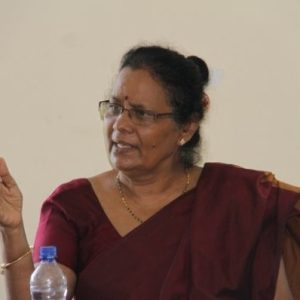
- Saroja Sivachandran is a prominent Sri Lankan women's rights activist and the founder and Executive Director of the Centre for Women & Development (CWD) in Jaffna, established in 1988 to empower marginalized women and girls, particularly those affected by the civil war.
- Her work focuses on gender equality, human rights, economic empowerment for war widows and displaced women, child protection, and transitional justice in post-conflict Sri Lanka, with research suggesting significant impacts on thousands of vulnerable families.
- She has held influential roles in national and international organizations, including as a bureau member of South Asians for Human Rights (SAHR) and a signatory to global statements on women, peace, and security, highlighting her contributions to broader advocacy efforts.
- Evidence leans toward her participation in key global events, such as the 1995 Beijing World Conference on Women, which shaped her approach to feminist activism and inspired ongoing programs in education, health, and violence prevention.
- While her efforts have been widely recognized, challenges in patriarchal societies and post-war recovery persist, underscoring the complexity of gender issues in Sri Lanka.
Background and Early Journey
Saroja Sivachandran holds an M.A. from the University of Peradeniya and has built a career centered on women's empowerment in Sri Lanka's northern regions. Amid the civil war, she founded CWD in 1988 as a non-profit NGO registered under the NGO secretariat in Colombo, aiming to address women's rights and support underprivileged communities. In 1995, despite displacement from Jaffna due to the conflict, she attended the Beijing World Conference on Women, traveling by boat to Colombo and then to Beijing as part of Sri Lanka's delegation. This experience introduced her to global feminist perspectives and solidified her commitment to gender equality.
Major Contributions and Roles
Sivachandran has participated in international forums, including the Geneva Human Rights Council and conferences by the Minority Rights Group. She serves as a core group member of the Council of NGOs Jaffna, governing council member of the National Peace Council, council member of the University of Jaffna, and member of the National Committee on Women under the Ministry of Child Development and Women’s Empowerment. In 2017, she was elected as a bureau member of SAHR, a regional human rights network spanning South Asian countries. More recently, in 2025, she endorsed an open statement to the UN Security Council marking 25 years of the Women, Peace, and Security agenda.
Impact on Post-War Recovery
Her insights highlight the struggles of war widows and female-headed households in Sri Lanka's north, where women have become primary breadwinners but face lower wages and patriarchal barriers. Through CWD, she has implemented programs for livelihood support, legal aid, and awareness on issues like domestic violence and child rights. Collaborations, such as with Australia's Ten for Tamils, provide rations, scholarships, and micro-finance to Tamil widows.
Ongoing Advocacy
Sivachandran continues to advocate for stronger legal protections against sexual violence and broader implementation of global commitments like the Beijing Platform for Action. Her work emphasizes economic empowerment, education, and health for women, reflecting a diplomatic approach that acknowledges the multifaceted challenges in post-conflict societies.
Saroja Sivachandran is a leading figure in women's rights and development in Sri Lanka, particularly in the Tamil-majority northern regions affected by the decades-long civil war that ended in 2009. As the founder and Executive Director of the Centre for Women & Development (CWD) in Jaffna, she has dedicated her career to empowering marginalized women and girls, addressing gender-based violence, promoting economic independence, and advocating for human rights in post-conflict settings. Her journey from a war-displaced activist to a global advocate exemplifies resilience and commitment to gender equality, influenced by pivotal experiences like her participation in the 1995 Beijing World Conference on Women.
Early Life and Education
While specific details about her early life are limited in available sources, Saroja Sivachandran holds a Master of Arts (M.A.) degree from the University of Peradeniya in Sri Lanka. This educational foundation likely equipped her with the analytical and leadership skills necessary for her advocacy work. Growing up in a context marked by ethnic conflict between the Sri Lankan government and the Liberation Tigers of Tamil Eelam (LTTE), she witnessed firsthand the disproportionate impact of war on women and communities in the north, which shaped her focus on gender issues.
Founding and Leadership of the Centre for Women & Development
In 1988, amid escalating conflict, Saroja Sivachandran established the Centre for Women & Development (CWD), also known as மகளிர் அபிவிருத்தி நிலையம், as an autonomous non-governmental organization (NGO) initially registered under Sri Lanka's Ministry of Social Services and later the Ministry of Defense. The organization began with a catalytic role in capacity-building on women's issues, operating in districts like Jaffna, Kilinochchi, and Mullaitivu. Due to the war's disruptions, its activities narrowed primarily to Jaffna, where it gained credibility by working with displaced and war-affected women. CWD has since obtained approvals from bodies like the Presidential Task Force (PTF) to implement projects, demonstrating its reliability.
CWD's vision is to improve women's social, economic, and political situations through advocacy and rights-based programs. Its mission includes serving as a resource center for women's organizations, enhancing knowledge on women's issues, strengthening collaborations with national groups, and fostering strategies to rebuild divided communities and prevent violence. Key stakeholders encompass board members, government officials (e.g., Grama Nilathari officers, divisional secretaries), women development officers, volunteers, and community-based organizations (CBOs).
Under Saroja's leadership, CWD has achieved numerous milestones:
- Conducted need assessment surveys for livelihoods among displaced populations.
- Documented data on war widows (utilized by national organizations) and missing persons.
- Provided capacity-building training for women in rural development societies.
- Established regional centers to document Violence Against Women (VAW) using ICTA-funded technology, including an online database for domestic violence cases.
- Ran awareness programs on international resolutions like CEDAW, UNSCR 1325, the Domestic Violence Act, and the Women’s Charter.
- Offered free legal aid for domestic violence victims, pioneering such services in Jaffna and taking cases to court.
- Published true stories of women facing domestic violence in local newspapers and collected narratives from displaced women in Vanni.
- Submitted reports to the Lessons Learnt and Reconciliation Commission (LLRC) on human rights violations.
- Organized annual events for International Women’s Day, Peace Day, and Human Rights Day.
- Conducted village-level gender and development training, leadership programs, and IT training for rural women and children.
- Developed training manuals and published a gender-based magazine.
- Held programs on good governance, democracy, and a three-month human rights course in collaboration with the University of Jaffna.
- Planned gender studies courses and school programs on reproductive health.
- Coordinated with hospitals, police, and courts for VAW support.
- Implemented livelihood activities funded by donors like SDC and DRC.
- Facilitated exchange programs with southern women's groups for peace-building.
- Organized seminars on post-war land disputes and international religious conferences (EU-funded).
- Distributed dry rations to flood- and cyclone-affected families in areas like Kayts, Badulla, Velanai, and Kopay.
- Celebrated Children's Day and Elders Day with online talks on rights and issues.
- Hosted International Peace Day events and a three-month certificate course on Children's Rights and Child Protection System, inaugurated by Sivachandran in 2021, covering policies, monitoring, and community support.
- Provided livelihood support for 150 persons with disabilities in districts like Kilinochchi and Vavuniya under Australian funding.
- Conducted consultations on transitional justice with CBOs in Jaffna and Puthukkudiyiruppu.
CWD's strengths include societal recognition, a committed board of academics, experienced staff, strong networks with women's organizations and the NGO Council, and capabilities in mobilization, reporting, and media engagement. Challenges involve political interference, staff turnover, language barriers (primarily Tamil-speaking staff), and delays in approvals. Values guiding the organization emphasize justice, equity, unity, peace, and people's participation.
Global and National Advocacy Roles
Saroja Sivachandran has built extensive networks with national and international women's organizations, government officials, and rural groups. She conducts gender programs for CWD and others, participating in global events such as the Geneva Human Rights Council conference and a Minority Rights Group conference. Domestically, she is a core group member of the Council of NGOs Jaffna, governing council member of the National Peace Council, council member of the University of Jaffna, and a member of the National Committee on Women, influencing policy on women's issues. She previously served on the advisory committee of the Ministry of Human Rights and has rapport with the Human Rights Commission in Jaffna.
In 2017, she was elected as a bureau member of South Asians for Human Rights (SAHR), a regional network of human rights defenders from countries including Afghanistan, Bangladesh, India, Maldives, Pakistan, and Sri Lanka. SAHR relies on members' expertise for stability and efficiency in advancing human rights.
In October 2025, Saroja Sivachandran endorsed an open statement to the United Nations Security Council on behalf of women peacebuilders, marking 25 years of UNSCR 1325 on the Women, Peace, and Security agenda. The statement highlights women's experiences in conflicts, calls for inclusion, critiques unmet commitments, and demands action amid global crises like wars, arms races, and shrinking civic spaces.
Participation in the Beijing World Conference and Lasting Influence
In 1995, during the height of Sri Lanka's civil war, Saroja Sivachandran and two CWD members were displaced from Jaffna but managed to attend the Fourth World Conference on Women in Beijing. They traveled by boat to Colombo and joined the national delegation organized by the Women's Media Institute. The conference, attended by 189 countries, resulted in the Beijing Declaration and Platform for Action, addressing 12 critical areas for gender equality, development, and peace.
Saroja Sivachandran describes the event as transformative, introducing feminist thinking to her activism and fostering global solidarity, friendships, and ideas. It shifted mindsets on preventing sexual harassment and assault, emphasizing women's economic empowerment, education, health, and poverty alleviation. Inspired by this, CWD implemented programs like livelihoods for war-affected women, legal support for land reclamation, micro-enterprises for women with disabilities, scholarships for impoverished students, psychosocial aid for sexual abuse survivors, awareness campaigns, leadership training for political participation, organic farming promotion, and strengthened ties with women's rights groups and international forums.
Thirty years later, she views the Beijing commitments as more urgent than ever, calling for gender equality across sectors, robust legal protections against sexual violence, and global adherence to the Declaration's principles. She credits the United Nations for amplifying women's voices and proving change is possible.
Insights on Post-War Challenges for Women in Sri Lanka
Sivachandran has been a vocal commentator on the gendered impacts of Sri Lanka's civil war. A 2010 CWD survey identified around 40,000 female-headed households in the north, including over 20,000 in Jaffna, due to war deaths, disappearances, and detentions. She notes that over 50% of these women are single parents under 30, supporting extended families amid displacement of over 280,000 people and an estimated 89,000 war widows in the north and east.
In post-war recovery, women have become breadwinners, often as day laborers in construction, but earn less than men (e.g., $1.25 daily vs. double for men) due to employers preferring "cheaper labor." Sivachandran explains, "It has become cheaper to hire women - men would demand higher daily wages. Women unquestioningly accept what is given, often because they have many mouths to feed." Security restrictions on fishing and farming exacerbate this shift, with some men becoming house-husbands.
Programs often overlook women's dual roles in providing income while managing households, childcare, and rebuilding. Sivachandran critiques, "Most programmes don’t take into account the unique role of women here," and notes women's inability to compete for male-dominated jobs like road-building. She advocates for targeted support in areas like poultry farming with market access for sustainable income.
In patriarchal Tamil society, war widows face isolation, depression, and barriers to aid. Sivachandran highlights that single women must compete with men for jobs and housing, despite women's wartime roles in the LTTE. Three years post-war (2012), unemployment and homelessness persisted, with only 17,000 of 100,000 needed homes under construction, and 13,000 still in camps due to landmines. She states, "Things have improved, but there is still a lot more to do," describing needs as overwhelming despite emerging cottage industries.
Collaborations and Public Engagement
CWD partners with organizations like Australia's Ten for Tamils, which supports Tamil widows through food programs, rations, employment, scholarships (including for University of Jaffna students), and micro-finance for small businesses. Sivachandran's role is central, as CWD implements these on the ground.
She maintains a public presence, with mentions on social media platforms like X (formerly Twitter). For instance, in 2025, UNFPA Sri Lanka highlighted her 30-year journey from Jaffna to the global stage. Earlier posts from 2012 by journalist DushiYanthini quote her on youth employment, monitoring guest houses post-war, educating Vanni communities, and school awareness programs on violence against women. In 2022, SAHR shared her message on International Human Rights Day.
Timeline of Key Achievements and Milestones
| Year | Achievement/Milestone |
|---|---|
| 1988 | Founded the Centre for Women & Development (CWD) in Jaffna, focusing on women's rights and empowerment. |
| 1995 | Attended the Beijing World Conference on Women, adopting feminist approaches that influenced CWD programs. |
| 2000s–2010s | Documented war widows, VAW, and missing persons; established legal aid and awareness programs; submitted to LLRC. |
| 2010 | Highlighted women's roles as breadwinners in post-war north via CWD survey (40,000 female-headed households). |
| 2011 | Critiqued aid programs for overlooking women's unique challenges in IRIN report. |
| 2012 | Commented on patriarchal barriers for war widows and ongoing unemployment/homelessness in northern Sri Lanka. |
| 2017 | Elected bureau member of South Asians for Human Rights (SAHR). |
| 2021 | Inaugurated certificate course on Children's Rights and Child Protection; organized transitional justice consultations. |
| 2022 | Celebrated International Women’s Day with advocacy on women’s political representation. |
| 2025 | Endorsed UN Security Council statement on 25 years of Women, Peace, and Security agenda; featured in UNFPA's Voices from Beijing series reflecting on 30 years of gender advocacy. |
Sivachandran's work remains vital in a region still recovering from conflict, where political interference and resource constraints pose ongoing hurdles. Her empathetic, diplomatic approach acknowledges all sides in debates on gender and peace, emphasizing collaboration and evidence-based advocacy. As she notes, the fight for gender equality is far from over, requiring sustained global and local efforts.
Key Citations:
- Saroja Sivachandran - Executive Director at Centre for Women & Development | LinkedIn
- Our Story - Ten for Tamils
- Women take over as breadwinners in north - The New Humanitarian
- SRI LANKA: Battles ahead for women - Sri Lanka Brief
- War widows struggle in patriarchal societies - Thomson Reuters Foundation News
- Legacy of war - unemployment and homelessness - Sri Lanka | ReliefWeb
- - Centre for Women & Development
- Open Statement to the United Nations Security Council on behalf of Women Peacebuilders Marking 25 Years of the Women, Peace, and Security Agenda
- The Way Forward: Reflections on the Beijing World Conference on Women
- About Us - Centre for Women & Development - WordPress.com
- Centre for Women & Development
Personal Life
Saroja Sivachandran is married to R. Sivachandran, a retired academic from the University of Jaffna. They have two children: Yalini Aravinthan (née Sivachandran), a dentist and owner of YaSmiles Dental Clinic in Canada, and Sivachandran Bharathi, a lead software engineer at Giesecke+Devrient.
References for Saroja Sivachandran
Below is a compiled list of references used or relevant to the biography, mapped to the citation IDs from the article. These are drawn from verified sources like official profiles, reports, and publications. I've included key details for each:
- [0] Ten for Tamils - Author: Saroja Sivachandran. Discusses her role in women's development and her 30+ years of advocacy.URL: https://tenfortamils.au/author/saroja
- [1] LinkedIn Profile: Saroja Sivachandran - Executive Director at Centre for Women & Development. Covers her professional experience and education.URL: https://lk.linkedin.com/in/saroja-sivachandran-99250132
- [2] UNFPA Sri Lanka Facebook Post: 30 years on, Saroja Sivachandran's journey from Jaffna to the global stage. Highlights her advocacy in women's rights and civil movements.URL: https://www.facebook.com/UNFPASriLanka/posts/30-years-on-saroja-sivachandrans-journey-from-jaffna-to-the-global-stage-reminds/1102624991906731
- [3] CWD Jaffna Facebook Post: Saroja Sivachandran elected as Bureau Member of SAHR. Notes her election to South Asians for Human Rights.URL: https://www.facebook.com/cwdjaffna/posts/saroja-sivachandran-has-been-elected-as-one-of-the-bureau-members-of-south-asian/1509937325726094
- [4] LinkedIn Profile: Saroja Sivachandran - NGO at Center for Young Womens Development. Additional professional details.URL: https://lk.linkedin.com/in/saroja-sivachandran-4509b6148
- [5] ICAN Peacework: Open Statement to the United Nations Security Council. Mentions her in the context of women peacebuilders.URL: https://icanpeacework.org/2025/10/open-statement-to-the-unsc-from-women-peacebuilders
- [6] Sri Lanka Two Blog: Women's and Minority Rights in Sri Lanka's Transitional Justice Process. Discusses her UN talk in Geneva.URL: https://srilankatwo.wordpress.com/2017/03/23/womens-and-minority-rights-in-sri-lankas-transitional-justice-process
- [7] Colombo Telegraph: Engagement In North Brings Encouraging Results. References her work with women's groups in Jaffna.URL: https://www.colombotelegraph.com/index.php/engagement-in-north-brings-encouraging-results
- [8] Ten for Tamils: Our Story. Details her founding of CWD and focus on marginalized women.URL: https://tenfortamils.au/about-us
- [9] IMADR: Busybody for Peace - The Life and Work of Nimalka Fernando. Contextual mention in women's rights networks.URL: https://imadr.org/wordpress/wp-content/uploads/2016/07/University-of-San-Diego_BUSYBODY-FOR-PEACE_Nimalka-Fernando_Sri-Lanka.pdf
- [10] GUPEA: Roles of Women During Armed Conflict. Interview excerpts on her advocacy.URL: https://gupea.ub.gu.se/server/api/core/bitstreams/f9e198b4-ff6b-4bd8-a4e3-1ec6907d32d7/content
- [11] South Asians for Human Rights: Triennial Report. Covers her involvement in SAHR activities.URL: https://southasianrights.org/wp-content/uploads/2023/03/SAHR_Annual_Report_9.pdf
- [12] Thuppahis: From Bio-tale and Anecdote to Issues of Housing and Ethnic Rapprochement in the North. Quotes her on community interactions.URL: https://thuppahis.com/2012/11/15/from-bio-tale-and-anecdote-to-issues-of-housing-and-ethnic-rapprochement-in-the-north
- [13] OHCHR: National Action Plan. Lists her in consultations for women's rights.URL: https://www.ohchr.org/sites/default/files/Documents/Issues/NHRA/NPASriLanka2011_2016.pdf
- [14] JDS Lanka Blog: Saturday, May 14, 2011. Mentions her directorial role and reports.URL: http://jdsrilanka.blogspot.com/2011_05_14_archive.html