Since 1988 CWD has worked on advocacy and rights-based programmes for women in Jaffna and the Northern Province. These are our main areas of work, with links to reports of each activity.
- Women-headed households
- Land rights
- Legal aid & VAW
- Awareness & training
- Peace & politics
- Children’s rights
- Livelihoods & disability
- Relief
Women-headed households and widows
After the war ended in May 2009, CWD carried out a field survey to gather information about the situation of war widows, land issues and other problems caused by the war. The priority issues identified were the livelihoods of female-headed households, land, social security, militarisation and illegal settlement, and the injured and elderly.
CWD’s data shows 54,532 women-headed households in the five districts of the Northern Province. With this information we met women, formed groups (particularly of widows) and conducted awareness and capacity development programmes. Many of the women are physically weak and mentally traumatised, and need psychological counselling.
We also formed groups of women-headed households in war-affected areas, such as Puthukudiyiruppu and Mankulam, and ran capacity-building programmes to develop leadership among them. Forming groups helped the women work with other organisations for social integration.
CWD has aligned with the Global Alliance for Widows of the Federation of SIGBI (Soroptimist International of Great Britain and Ireland).


Women’s land rights
Land is deeply and emotionally linked to family and identity. When resettlement began, displaced families needed documentary proof to take up residence in their own places, and war widows, wives of the disappeared, mothers of disappeared children and people without legal documents faced great difficulty.
CWD has conducted many programmes on land rights for displaced women and widows to help them get their own land back. CWD’s lawyers assisted women who had lost their legal documents to get them back through the authorities concerned. Women’s groups were empowered to fight for their rights, and group leaders initiated campaigns and protests calling for their lands to be released.
CWD surveyed land issues, interviewed affected women, collected data from officers in each division and, with seminars facilitated by retired Land Commissioner Mr. K. Gurunathan, published a book on land issues and women in the Northern Province. It was launched on 30.10.2013 by the Northern Provincial Land Commissioner, Mr. K. Maheswaran.

Legal aid and ending violence against women
CWD established a free legal aid unit to address domestic violence cases. We were the pioneers of establishing such a centre in Jaffna. With the help of lawyers, women affected by domestic violence file cases in the courts.
Through our legal access to justice programme we conduct gender-based violence programmes for women, particularly war widows, to provide legal information and explain the reporting procedures available. We also organise free legal service camps, where lawyers and officials help people with birth, death and marriage certificates, identity cards, land registration and cases of the missing and of violence.
Funded by ICTA, CWD documented violence against women using information technology, set up five regional centres and created an online database of domestic violence data. With ICTA support we also produced an animated cartoon and two short films based on reported stories; 1,500 DVDs were distributed to organisations for campaign work across the North and East. We published 25 true stories of women who experienced domestic violence in three local newspapers.


Awareness and training
CWD runs awareness programmes on international instruments and resolutions, including CEDAW, UN Security Council Resolution 1325, the Domestic Violence Act and the Women’s Charter, as well as human rights, good governance and democracy, legal matters and project design.
- Gender and development training at village level, leadership training, and training-of-trainers programmes
- A three-month human rights course with Extra-Mural Studies, University of Jaffna, and a three-month diploma course on UNSCR 1325 and human rights
- Awareness seminars for village-level women under an EU project, on non-violent communication, legal advice, UNSCR 1325 and women’s role in post-war peace-building
- School awareness programmes for students above Grade 10, reaching 2,000 students in six schools
- Training manuals and a gender-based magazine


Peace-building and women in politics
In collaboration with the National Peace Council, CWD organised district peace action groups of civil society members, religious leaders and other important personalities, to identify problems within the community and try to solve them peacefully. Exchange visits linked Jaffna with Puttalam, Hambantota, Ampara and Monaragala, and seminars brought displaced Muslim women and Tamil women together for better understanding (EU project).
CWD trains and encourages women to stand for election. In 2016 we trained 150 women across Jaffna, Kilinochchi, Mannar, Mullaitivu and Vavuniya who were willing to contest local government elections. In 2022, with Search for Common Ground, we handed over an advocacy paper on women’s representation in local authorities. CWD also submitted proposals for constitutional reform in 2016.


Children’s rights
In 2021 CWD conducted a three-month online certificate course on Children’s Rights and Child Protection System for more than 50 participants from NGOs, Pradeshiya Sabhas and universities. We celebrate Children’s Day with competitions, cultural shows and talks.
Our educational assistance programme provides school-going children with note books, pens, school bags, shoes and even bicycles. This has helped reduce school drop-outs in the displaced community. Saroja Sivachandran’s handbook on children’s rights was launched on International Children’s Day 2012.


Livelihoods and disability
CWD has started many livelihood programmes for war widows and war-affected women, including home gardening, small businesses, food making and selling, dry fish selling, chilli powder making, boutiques, poultry, cow and goat rearing, preschools and grinding mills.
With The Asia Foundation, CWD gave 25 war-affected women in Jaffna livelihood assistance and training in coir products, small business, sewing and goat rearing. We provide batik training for young women, organised an exhibition of products made by women entrepreneurs, and with Australian DAP funding gave livelihood support to 150 persons with disabilities in Puthukkudiyiruppu, Kilinochchi, Vavuniya and Mannar. Earlier livelihood activities for displaced women and children were funded by SDC and DRC.


Emergency relief
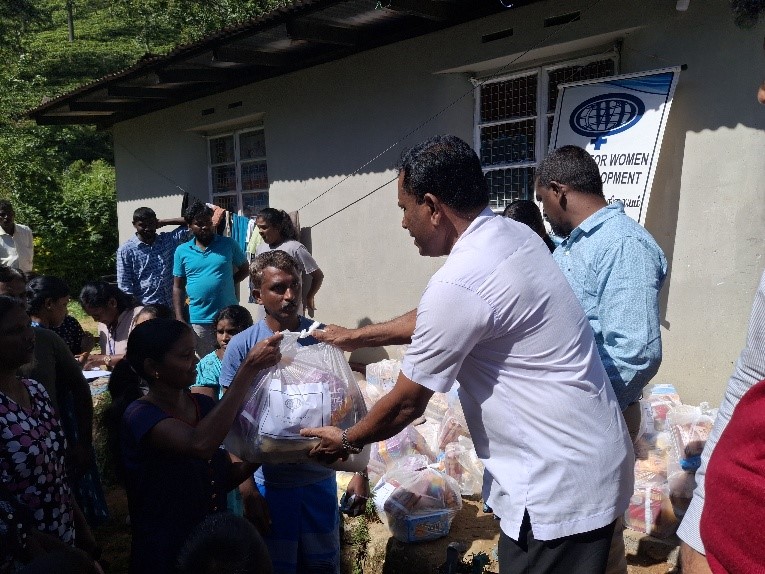
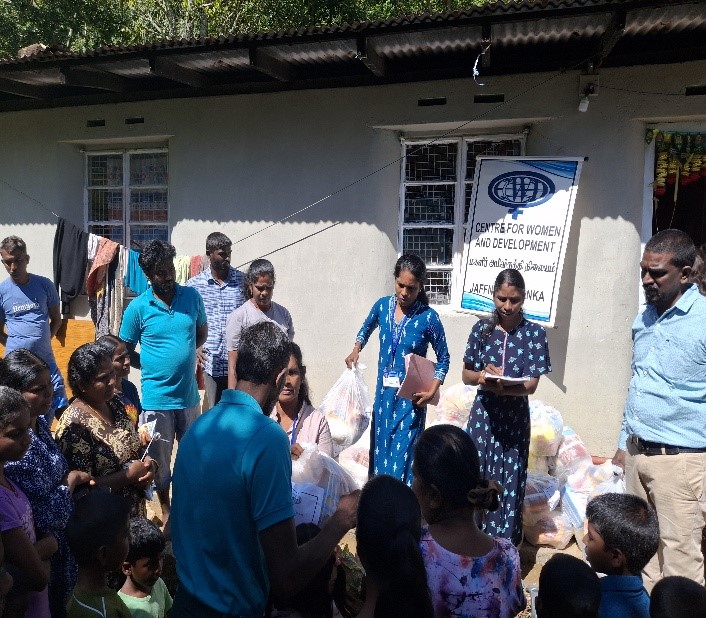
Sponsored by Ten for Tamils, CWD distributed dry-ration packs to families displaced by floods and Cyclone Ditwah. They included families sheltering in schools in Velanai and Kopay, 30 vulnerable families in Kayts, 64 families in Badulla affected by landslides, and members of the mental health community at Mannar District Hospital.